How Coding and Robotics Empower Students at the Best School in Vasundhara Ghaziabad
Coding and robotics are not subjects for future computer scientists. They are thinking tools for every child who will grow up in a world built on technology. At Allenhouse Public School, the best school in Vasundhara Ghaziabad, coding begins in primary school and robotics is a curriculum-linked programme. This blog covers what students actually learn and why it matters.
Introduction
A Class 6 student built a small robot that could detect an obstacle and change direction. She had not been told exactly how to do it. She had been given the components, a problem and enough prior knowledge to attempt a solution. It took three sessions, two significant failures and one adjustment she figured out herself.
When it worked, she did not celebrate the robot. She celebrated the moment she understood why it had been failing. That moment, the gap between a thing not working and understanding why, is where coding and robotics education actually lives. It is not about the finished product. It is about what happens in the mind of the student during the process of building it.
At Allenhouse Public School, Vasundhara, the best school in Vasundhara Ghaziabad, we have built our coding and robotics programmearound creating exactly these moments, deliberately, progressively, across every year of the K-12 journey.
What Coding and Robotics Are in a School
It is worth being specific, because both terms get used loosely in school marketing and the reality matters more than the label.
Coding
Coding in a school context is the teaching of computational thinking through programming. It begins with visual, block-based tools that introduce the logic of sequences and conditions without requiring students to remember syntax and progresses through structured languages like Python as students develop the conceptual foundation to use them meaningfully.
Robotics
Robotics in a school context is the application of coding to physical systems. Students build machines, programme them to behave in specific ways, test whether they behave as intended and diagnose why they do not when they fall short. It is the most complete form of project-based learning available in a school setting, because it connects digital thinking to physical reality in a way that is immediately, undeniably visible.
Together, coding and robotics are not two separate programmes. They are two aspects of the same capability: the ability to define a problem, design a solution, build it, test it and improve it. This is the digital education in Ghaziabad that actually prepares students for what comes next.
Why Coding Should Begin Early and What Early Actually Looks Like
The question parents ask most often is: when should my child start learning to code? The answer at Allenhouse is Class 3 and the reasoning is worth understanding rather than simply accepting. At age eight or nine, children are in a developmental window where abstract logical thinking is beginning to consolidate. They are old enough to understand the relationship between an instruction and its consequence and young enough that the exploratory approach of visual coding tools feels natural.
Starting here means something specific:
Class 3 and 4: Students work in Scratch, creating animations and simple games through drag-and-drop logic blocks. The focus is on sequence, loops and conditions — the three fundamental structures that underlie all programming
Class 5 and 6: Students move toward text-based introductions, beginning to write simple Python programmes and understanding variables, functions and basic data structures
Class 7 and 8: Projects increase in complexity. Students build programmes that solve real problems, work with data and are introduced to AI concepts as natural extensions of the computational thinking they have been developing
Class 9 onwards: Students engage with application development, data analysis and the kind of technical problem-solving that connects directly to higher education pathways in engineering, computer science and technology
The progression is designed so that by the time board examinations arrive, coding is not a new subject students are managing under pressure. It is a mode of thinking they have been practicing for six or seven years.
Inside the Robotics Lab: What Students Actually Do
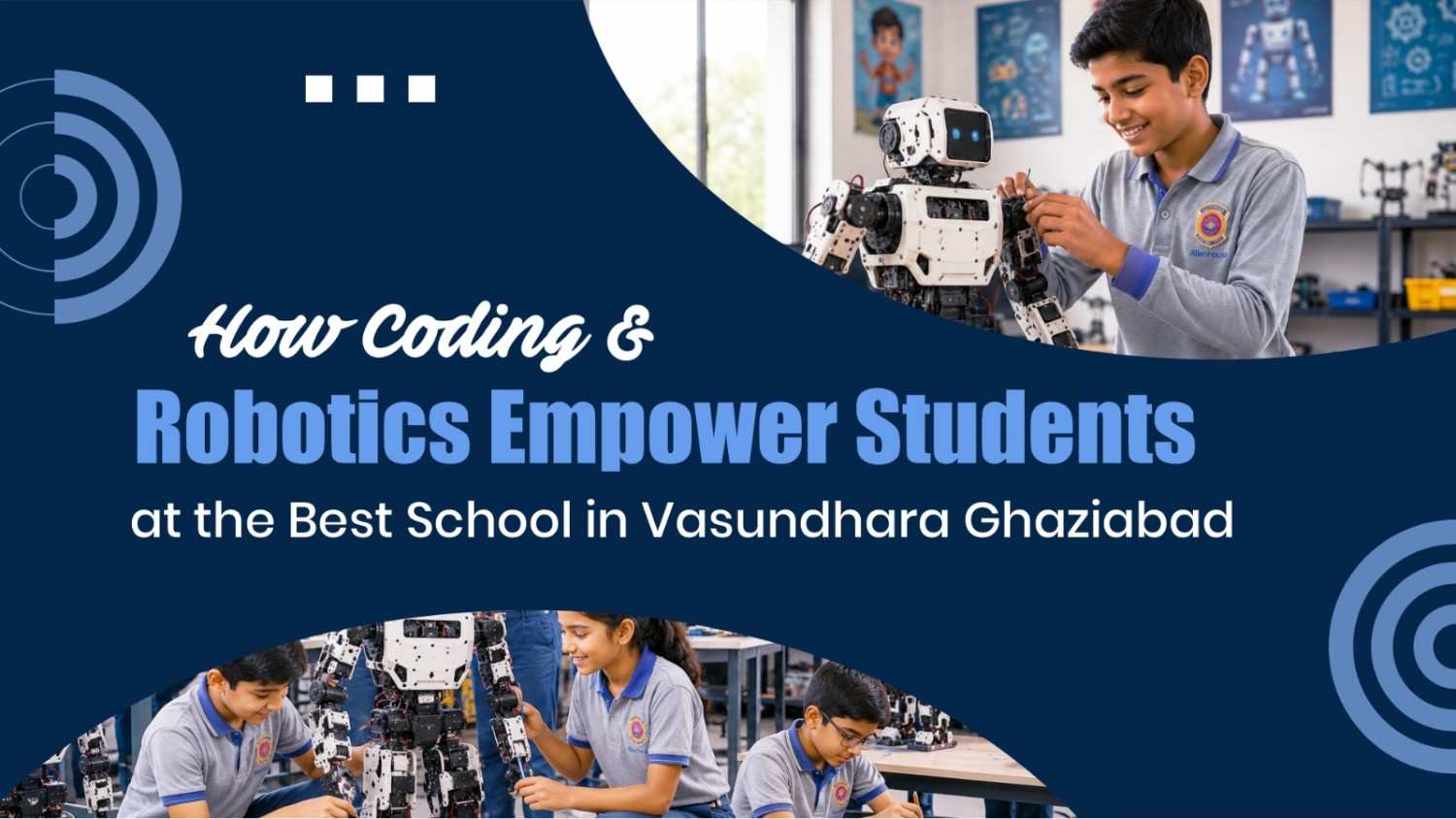
A robotics lab that is only opened for school visits is not a robotics lab. It is a display case. At the best school in Vasundhara Ghaziabad, the Robotics Lab is a working environment used regularly across class levels, with curriculum-linked challenges that build progressively in complexity.
What a typical robotics session looks like:
A group of students receives a challenge instead of a template. A challenge: build a machine that can sort objects by colour, or navigate a maze using sensors, or carry a load across a specified distance without dropping it. They have their prior knowledge, access to components and a time constraint.
At Allenhouse, what follows is one of the richest learning environments a school can create:
Students have to define the problem precisely before they can design a solution. This way they build the analytical habits that strong thinkers in every field share
Design decisions require reasoning: why this approach rather than that one, what trade-offs are acceptable as well as what is the minimum viable version
Building requires collaboration, distributing tasks, integrating work as well as communicating clearly about what each person is responsible for
Testing reveals the gap between theory and reality and this exactly is where the most important learning happens
Failure is not the end of the session. It is data about what to fix
The annual Tech Fest at Allenhouse gives students a public stage for what they have built, adding the communication and presentation dimension to the technical one. A student who can build something and explain it clearly to an audience is a student who understands it at a different depth than one who simply submitted it.
How Coding and Robotics Build Specific Skills
Let’s look into the skill-building aspect of both coding and robotics:
Problem-Solving
Every coding task begins with a problem and ends with a solution that either works or does not. The process in between, breaking the problem into components, designing an approach, testing, identifying failure points, adjusting, is problem-solving in its most structured and honest form. Students who practice this regularly develop a fundamentally different relationship with difficulty than those who have not.
Logical Reasoning
Code is unforgiving. It does exactly what it is told, which means that when it does the wrong thing, the error is always in the logic, not in the machine's mood or interpretation. Students who code regularly develop precision in their thinking because imprecision has immediate, visible consequences.
Creativity and Innovation
There is no single correct solution to a robotics challenge. Students approach the same problem from different angles and produce different working solutions, all of which are valid. This open-endedness is one of the most powerful aspects of coding and robotics education: it develops the creative confidence to attempt something new alongside the technical rigour to execute it.
Confidence and Resilience
A student who has debugged a programme that was not working and found the error has experienced something important: the failure was temporary, the solution was findable and they were capable of finding it. That experience, accumulated across years of coding and robotics work, builds a specific kind of resilience that academic success alone does not always produce.
Collaboration
Robotics projects are almost always team efforts, which means students practice the interpersonal skills of technical collaboration: explaining their own reasoning, understanding someone else's approach, resolving disagreements about design decisions and integrating work that was done separately into a coherent whole.
Coding, Robotics and Academic Performance
Parents sometimes worry that time spent on coding and robotics is time taken away from core academic subjects. The evidence suggests the opposite relationship.
Students who develop strong computational thinking show measurable improvements in mathematics, because the two disciplines share the same underlying cognitive structures.
Science performance benefits from the experimental mindset that robotics builds: hypothesise, test, observe, adjust.
The thinking skills built in the coding lab transfer directly into how students approach examination questions, particularly the application-based questions that the CBSE board has increasingly prioritised.
At Allenhouse, a top-rated CBSE school in Ghaziabad, our 100% board pass rate and strong high-distinction percentages exist alongside, not despite, our investment in coding and robotics education.
From Coding to Careers: What Students Are Actually Being Prepared For
The career pathways that connect directly to coding and robotics education are broader than most families initially assume.
The World Economic Forum consistently identifies analytical thinking, creative problem-solving and technology fluency among the top skills employers across industries will require in the coming decade. Coding and robotics education at Allenhouse builds all three, not as separate programmes but as integrated outcomes of the same consistent practice.
What Parents Should Look For in a School's Coding and Robotics Programme
For families evaluating schools in Vasundhara and the wider Ghaziabad area, the questions worth asking go well beyond "do you have a robotics lab?"
At what class level does coding instruction begin and is it curriculum-linked or extracurricular?
What is the progression across class levels? Is there a coherent pathway from primary to senior secondary?
Is the robotics lab used regularly across the academic year or opened for specific events?
Are coding and robotics connected to each other and to other subjects, or treated as separate programmes?
Do students have opportunities to present their work publicly and receive feedback?
How are students assessed on coding and robotics work and does that assessment reward process alongside outcome?
At Allenhouse Ghaziabad, every one of these questions has a specific, confident answer. Families are welcome to visit the Coding Lab and Robotics Lab during a campus visit and see the programme in use rather than on display.
Conclusion
Coding and robotics education at the best school in Vasundhara Ghaziabad is not about producing software engineers from Class 3. It is about producing thinkers who approach problems with the expectation that they can be solved, who have practiced the discipline of building something from nothing and who have experienced enough failure and enough recovery from failure, to know that difficulty is not a signal to stop.
At Allenhouse Public School, Vasundhara, this programme runs across the full K-12 journey, connected to our broader digital skills curriculum, our STEAM integration and the academic culture that produces consistent board results alongside genuinely future-ready students. For families in Vasundhara and across Ghaziabad looking for a school where coding and robotics are taken seriously as educational tools and not marketing features, we would like to show you what we have built.
Your Queries Answered
1. What makes a school the best for coding and robotics?
A strong coding and robotics programme starts early, follows a structured curriculum, offers hands-on lab learning and builds skills progressively. At the best school, it should connect coding with problem-solving, STEM subjects and real-world applications instead of treating it as an extracurricular activity.
2. What is the best age for children to start learning coding?
Most children can begin learning coding between ages 8 and 9. Starting with visual programming helps develop logical thinking before progressing to text-based languages like Python as they grow.
3. Why is coding important for school students?
Coding develops logical thinking, creativity, problem-solving and computational skills. It also helps students understand technology better and prepares them for future careers in a digitally driven world.
4. How does robotics help students in academics?
Robotics strengthens problem-solving, teamwork and analytical thinking. These skills improve learning in subjects like mathematics and science while encouraging creativity, experimentation and practical application of concepts.
5. How are coding and robotics connected?
Coding provides the instructions that make robots perform tasks, while robotics applies coding to solve practical problems. Together, they help students understand programming, engineering and automation through hands-on learning.