Why Digital Literacy Is Essential for Students at the Best School in Ghaziabad
Digital literacy is not limited to being able to use a smartphone. It is knowing how to think in a world shaped by technology. It is about understanding how to create rather than only consume as well as how to stay safe in environments designed to distract and manipulate. At the best schools in Ghaziabad, digital literacy is built into every year of the K-12 journey, which is what we'll explore in this article.
Introduction
There is a difference between a student who uses technology and a student who understands it. The first student scrolls, searches and submits. They can use an app, find a video, send a message. They are, in the most surface-level sense, digitally capable. The second student has digital literacy. They approach a screen the way a skilled reader approaches a text- with curiosity, critical awareness and the ability to create as well as consume. They understand that the information environment they live in is designed. At thebest schools in Ghaziabad, this kind of education is built through digital literacy programmes. Let us learn why it is important and what it constitutes.
What is Digital Literacy? How Does it Help Students?
Digital literacy is frequently confused with computer literacy and the confusion matters because the two are genuinely different things. Computer literacy is the ability to use specific tools: a word processor, a spreadsheet, a search engine. It is a practical skill set with a relatively low ceiling. A person can be highly computer literate and still be genuinely vulnerable to misinformation, algorithmically manipulated attention and the inability to evaluate the quality of what they find online.
Digital literacy is broader and more demanding. It includes:
Information literacy: the ability to find, evaluate and use information critically, distinguishing reliable from unreliable, understanding how search results are generated and what they exclude
Communication and collaboration: the ability to communicate effectively and appropriately across digital platforms, understanding audience, context and consequence
Digital creation: the ability to produce content, code and creative work in digital environments, not only receive it
Cyber safety and privacy: the understanding of how personal data works, how digital threats operate and how to protect oneself online
Critical thinking about technology: the ability to analyse how digital systems work, who benefits from them and what their limitations are
Digital citizenship: the ethical and responsible use of technology, with genuine awareness of how online behaviour affects real people and real communities
A student with genuine digital literacy is not just safer online. They are more capable academically, more competitive professionally and more equipped to participate meaningfully in a society that is increasingly organised through digital systems.
Why Digital Literacy Is a Life Skill?
When digital literacy is kept as a subject, taught in a specific period and assessed in a specific way, it misses the point entirely. Digital literacy is a life skill in the same category as critical thinking and communication or even financial awareness. It applies everywhere and across every subject. A student who has genuinely developed it does not switch it on for computer class and off for everything else. It shapes how they read, research, evaluate a claim and decide whether to share something or not. This is why the best school in Ghaziabad does not teach digital literacy as an isolated curriculum component.
At Allenhouse, it is woven across subjects:
A Class 5 student asked to research a science topic is being taught information literacy alongside science
A Class 8 student presenting findings using a digital tool is developing digital communication alongside their subject content
A Class 10 student learning to recognise bias in online sources is developing critical thinking that will serve them in every subject and beyond
How Coding Builds Digital Literacy?
Understanding technology at the literacy level requires some understanding of how it works. This is why coding is not separate from digital literacy at Allenhouse. It is one of its most powerful foundations. A student who has written a programme and experienced the relationship between an instruction and its output has a fundamentally different relationship with the digital systems around them than one who has only ever been a user.
They understand that apps and platforms are designed by people with specific intentions and that those designs shape user behaviour
They recognise that algorithms are not neutral, that they reflect the priorities of whoever built them
They approach digital tools with the confidence of someone who knows, at least in principle, what is happening inside them
At Allenhouse, coding begins at Class 3 through visual programming environments and progresses through structured programming languages by middle school. By the time students reach senior secondary, they have the computational thinking background that makes AI literacy, data analysis and advanced digital creation genuinely accessible.
How Robotics Makes Digital Literacy Tangible?
If coding gives students the language of digital literacy, robotics gives them the hands-on experience of applying it to physical problems. The two together produce something neither achieves alone: a student who can think digitally and build physically, which is increasingly the combination that innovation requires.
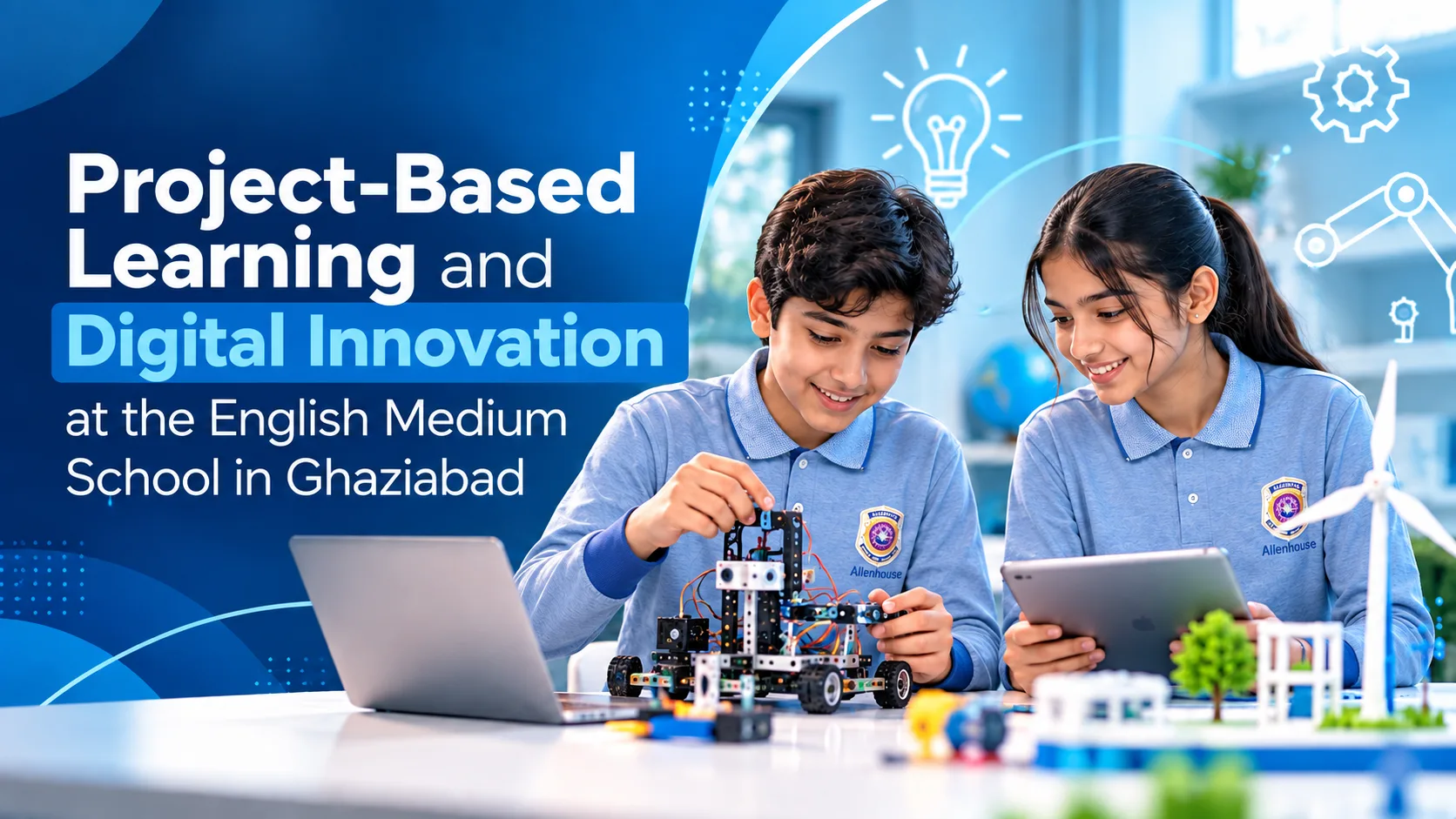
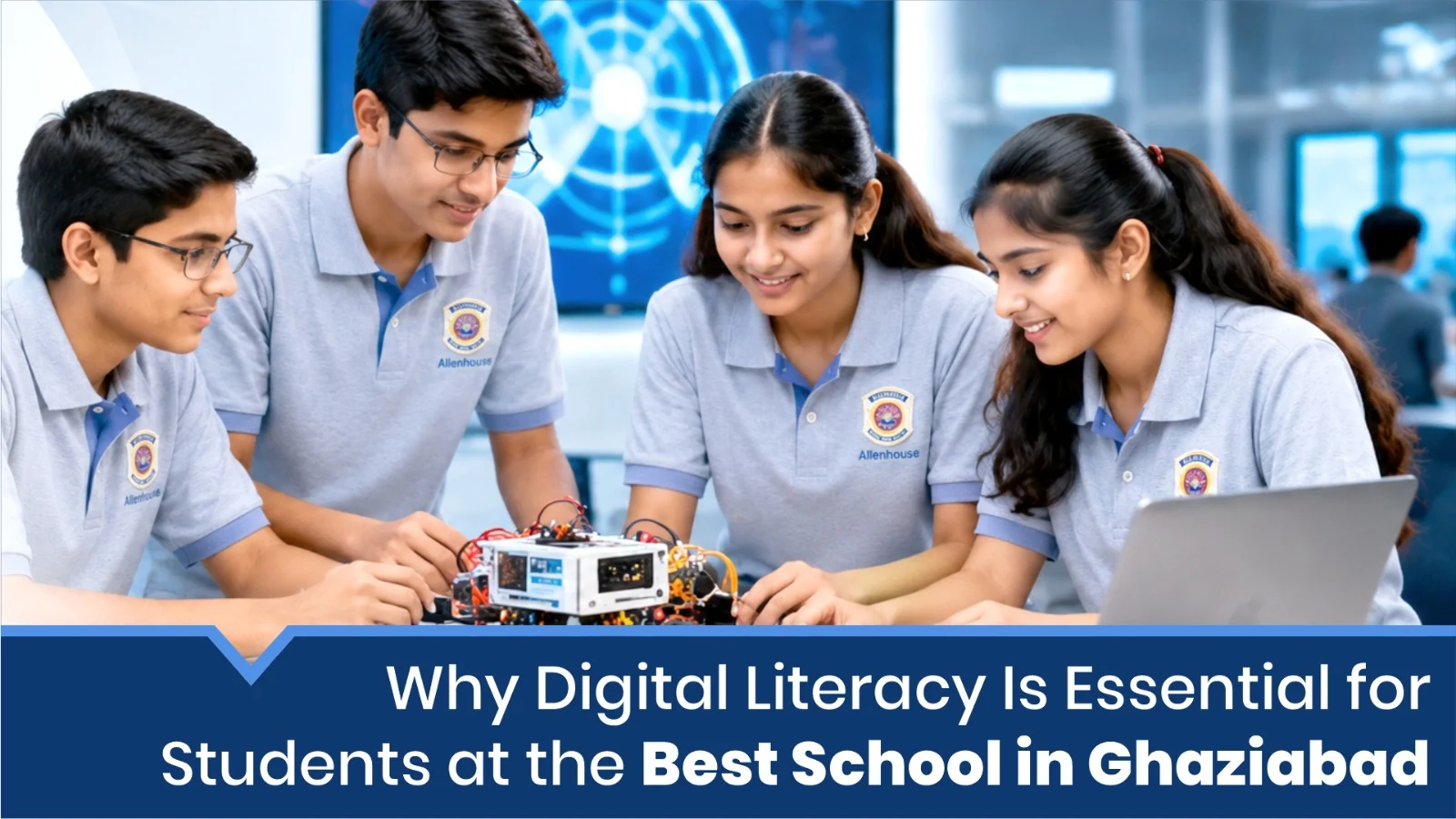
In Allenhouse's dedicated Robotics Lab, students work with age-appropriate kits and real engineering challenges across class levels.
They programme machines to respond to their environment, building the sensory-to-response logic that forms the base of everything, be it self-driving cars or medical diagnostic tools
They work in teams, distributing technical and creative responsibilities and integrating their work, which develops the collaborative dimension of digital literacy
They experience failure as information rather than verdict, because in a robotics challenge a robot that does not work is a robot that is telling you what to fix
They present their work at the annual Tech Fest, adding the communication dimension to the technical one
AI Literacy: An Important Skill to Learn Today
Every student is already living in an AI-shaped environment. Their search results are ranked by AI. Their social feeds are curated by AI. The autocomplete on their keyboard is AI. The question is not whether they will engage with artificial intelligence. It is whether they will understand it well enough to engage critically.
From Class 6 onwards, Allenhouse introduces structured AI literacy as part of the digital skills curriculum.
Students learn how AI systems work conceptually, what training data is, how pattern recognition produces recommendations as well as where AI succeeds and where it fails
They explore real-world applications across sectors (healthcare, agriculture, creative industries), building an understanding of AI as a broadly applicable capability instead of it being a technology belonging only to computer science
They engage with ethical dimensions: bias in AI systems, privacy implications, the accountability questions that arise when automated systems make consequential decisions
They use AI tools actively and critically, learning to evaluate AI-generated outputs rather than accepting them uncritically
A student who understands AI is not intimidated by it. They are equipped to work alongside it and to make the judgments that AI systems cannot make for themselves.
Critical Thinking: The Most Urgent Part of Digital Literacy
The information environment students navigate daily is not neutral. It is designed, by platforms with commercial incentives, to capture and hold attention. Misinformation spreads faster than corrections. Algorithms surface content that provokes reaction rather than content that informs. A student without critical digital thinking skills is navigating this environment without a map.
At Allenhouse, information evaluation is taught explicitly across subject areas.
Students are taught to trace claims to their source before accepting or sharing them
They learn to distinguish between different types of online content: reporting, opinion, advertising and propaganda
They understand how search engines work and what a result's ranking does and does not indicate about its reliability
They practice lateral reading, the technique of opening multiple sources simultaneously to cross-check claims, which research shows is the method used by professional fact-checkers
These skills are not taught once and assumed retained. They are practiced repeatedly across subjects and class levels, because critical thinking is a habit, not a lesson.
Cyber Safety: An Important Aspect of Digital Literacy
Digital literacy without cyber safety is incomplete. A student who can code, evaluate sources and use AI tools critically but who does not understand how their personal data works, or how phishing attempts are constructed, or what the consequences of oversharing can be, is still genuinely vulnerable.
At Allenhouse, cyber safety education is age-appropriate and progresses across class levels.
Primary students learn basic concepts of personal information and online strangers
Middle school students learn about password security, privacy settings and the permanence of digital footprints
Secondary students engage with more complex questions: data privacy law, cyberbullying and its consequences, the ethics of digital surveillance and how to respond when something goes wrong online
How Smart Classrooms are Daily Digital Learning Environments?
Digital literacy is also built through the everyday experience of learning in environments where technology is used purposefully and consistently. At Allenhouse, every classroom is equipped with Oluxi Smart Class technology: interactive digital boards, cloud-based learning tools and multimedia content integrated into daily instruction. Students do not encounter technology only in dedicated technology periods. They experience it as a normal, purposeful part of how learning happens.
Smart boards used for interactive problem-solving rather than passive note display
Cloud-based tools for collaborative assignments that develop digital communication alongside content knowledge
Digital research tasks embedded into subject learning from primary level onwards
Student presentations using digital tools building both content mastery and digital creation skills
What Parents Should Look For in a Digitally Advanced School?
For families evaluating top CBSE K-12 schools in Ghaziabad on the basis of digital readiness, the questions worth asking go beyond "do you have a computer lab?"
Is coding taught from primary school, or introduced only in secondary?
Is digital literacy woven across subjects, or siloed into a single technology period?
Does the school teach students to evaluate online information critically, or only to find it?
Is AI literacy part of the curriculum, with structured age-appropriate content?
Are robotics and STEAM programmes curriculum-linked, or occasional events?
How does the school approach cyber safety education across different age groups?
Do teachers use technology as a daily teaching tool, or primarily for administrative purposes?
Allenhouse Ghaziabad has built its programme to answer each of these questions specifically and affirmatively. Families are welcome to visit the campus, see the technology ecosystem in use and ask these questions directly of our team.
Conclusion
Digital literacy is not a subject. It is not a period on a timetable. It is the set of thinking habits, technical skills and critical awareness that determines whether a student is shaped by the digital world or equipped to shape it.
At Allenhouse Public School, the best school in Ghaziabad for this kind of future-ready education, we have built digital literacy into the architecture of our K-12 programme, from Class 3 coding to Class 12 AI literacy, from daily smart classroom learning to the annual Tech Fest where students present what they have built. The students who come through this programme do not just know how to use technology. They know how to think with it, about it and beyond it. That distinction is what will matter most in the world they are growing into.
Your Queries Answered
1. Why is digital literacy important for students?
Digital literacy is the ability to use, evaluate, create and communicate information safely and responsibly using digital technologies. It helps students think critically, stay safe online and use technology effectively for learning and everyday life.
2. How does coding support digital literacy?
Coding helps students understand how technology works while developing logical thinking, creativity and problem-solving skills. When coding is introduced in junior classes and progresses through higher grades as part of the digital learning programme, it creates a strong tech base.
3. How do top CBSE K-12 schools in Ghaziabad teach digital literacy?
Leading CBSE schools integrate digital literacy across subjects instead of teaching it as a separate topic. Students learn coding, AI, cyber safety, information evaluation and digital skills through practical, real-world learning experiences.
4. What cyber safety education does Allenhouse provide?
Allenhouse teaches age-appropriate cyber safety, including online privacy, password security, responsible internet use, digital footprints and cyberbullying awareness. The programme helps students become safe and responsible digital citizens.
5. How can I apply for admission to Allenhouse Ghaziabad?
Parents can contact Allenhouse Ghaziabad through the admissions team to schedule a campus visit and begin the application process. Admissions include an enquiry, application submission, a student interaction or assessment and fee confirmation.